Warbird Stories: P-51 Mustang From ‘Spam Can’ To ‘Dolly’
FEB 28, 2023
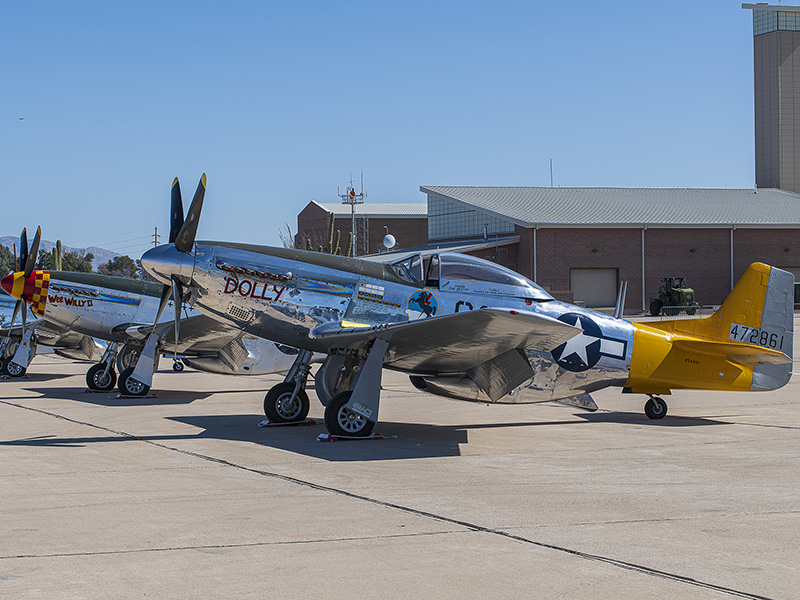
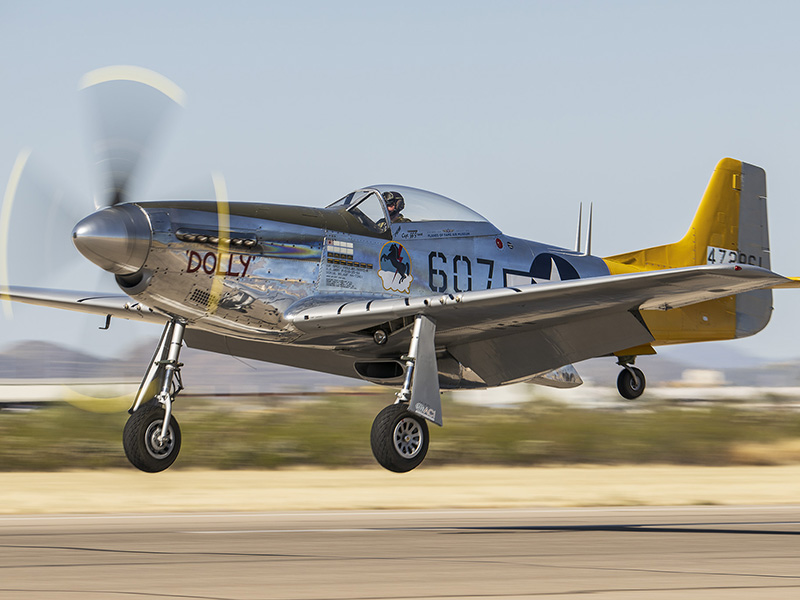
Despite having had one owner for more than six decades, “Dolly” has donned a variety of designs and paint schemes throughout its time in the skies. Featuring a Pacific Theater-inspired paint scheme rare among P-51s, “Dolly” showcases the Mustang’s broader military aviation history and has become a staple for Warbird enthusiasts by perfectly embodying the spirit of this beloved fighter.
First commissioned into service in 1945, the aircraft that would become known as “Dolly” – originally named “Spam Can” – was the 40th of 200 P-51D variants built in Dallas, Texas. In late 1947, the aircraft was assigned to the 31st Fighter Group out of Turner Air Force Base in Albany, Georgia, and served with the Strategic Air Command for two years. From 1949 to 1956, “Spam Can” served with Air National Guard units in Tennessee, Vermont and West Virginia until it was acquired by the Planes of Fame Air Museum in 1957, making it the longest privately held Mustang under the same owner.
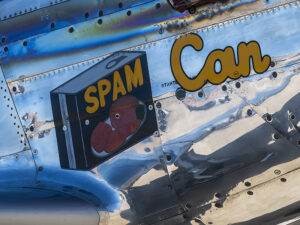
Though “Spam Can” was retired from active duty, its story was just beginning. The aircraft was named by Walter “Bud” Mahurin, a flying ace for the U.S. Army Air Forces during World War II and museum board member at the time. As a pilot of P-47s and F-86s for the majority of his career, the name “Spam Can” paid homage to the term Bud and most fighter pilots used to refer to prop planes during the 1950s.
More Warbird Stories
- Val-Halla P-51 Mustang
- The Proud American A-1 Skyraider
- 23-Skidoo P-38 Lightning
- Jolley Roger F-86 Sabre
- Happy Jack’s Go Buggy P-51 Mustang
“In Bud’s days, he affectionately called all his aircraft ‘spam cans,’ so it’s always carried that name even though its paint scheme has changed,” said former Air Force Heritage Flight pilot and Planes of Fame Air Museum President Steve Hinton Sr.
During its active service years, the aircraft originally had a black and white paint scheme with the iconic D-Day invasion stripes, which it kept once it was purchased in 1957 before being stripped down to the bare metal upon the museum’s move to Ontario in 1961. The museum relocated for a second time to Chino, California, in 1970, where Hinton Sr. and fellow pilot Jim Maloney were able to take their first flight in “Spam Can.” Hinton Sr. and Maloney then repainted “Spam Can” in the style of the B-17G “Wee Willie.”
“That was a paint job that Jim and I liked the most,” Hinton Sr. said. “We met the pilot who flew with that scheme during World War II, so we chose it in his honor.”
During the early 1980s, Hinton Sr. and Maloney dedicated time to rebuild and restore “Spam Can” to its original glory, including a series of new paint jobs such as purple stripes in promotion of the Phoenix 500 Air Races and a silver scheme for its appearance in the “Baa Baa Black Sheep” television series. With the exception of its restoration years, “Spam Can” has been maintained and flown since it was decommissioned from military service.
In 1985, “Spam Can” was renamed and updated to the present “Dolly” paint scheme, inclusive of its defining yellow tail, to honor the fighter squadrons that flew long-range escort missions with B-29s in the Pacific Theater.
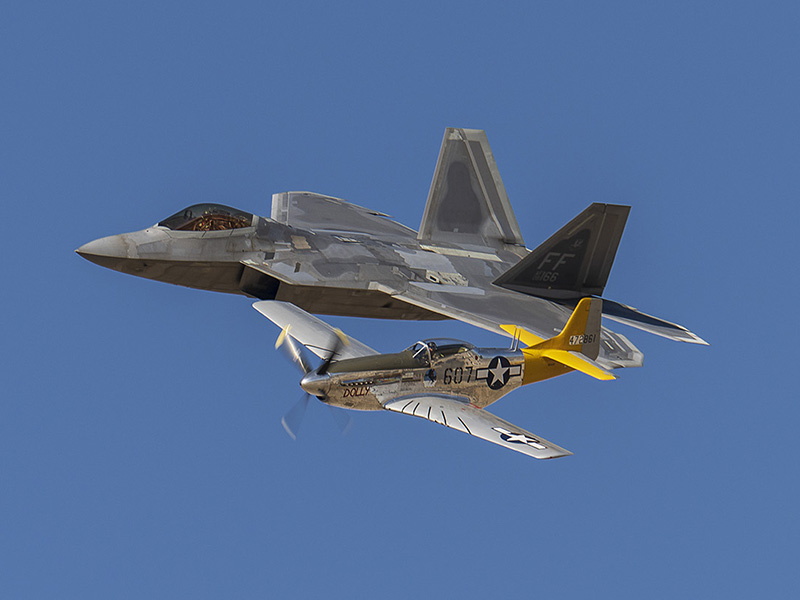
“Very few Mustang paint schemes recognize the Pacific, so we wanted to pick a Pacific color scheme. It’s an incredible story for how long they flew to escort the B-29s over Japan,” said Hinton Sr. “To this day, ‘Dolly’ flies regularly, participating mostly with the Heritage Flight team alongside many other Mustangs.”
In the true spirit of the P-51 Mustang, “Dolly” has stood the test of time, but not without the support of the museum and those dedicated to the aircraft’s care and upkeep. Hinton Sr. and others work on the aircraft frequently to maintain it in top flying condition.
“We operate Mustangs more than any other warbirds, and they really are the most reliable, especially for the last 15 years or so. The reliability of the engines has proved itself through history,” Hinton Sr. noted. “It’s just an amazing engine. With its horsepower and racing capabilities, there just isn’t another one like it.”
Along with its impressive military career, “Dolly” has gained notoriety by participating in flyovers at the Rose Bowl and appearing in various films and television shows, most notably in “12 O’Clock High,” a military drama set during World War II that followed the missions of the fictitious 918th Bombardment Group of the U.S. Army Air Forces.
“Dolly” has become a mainstay for aviation fans and Warbird pilots alike. The aircraft used to be one of the only flight-ready Mustangs, and today “Dolly” is often the first Mustang Heritage Flight pilots have the opportunity to fly as part of their training. For generations, pilots have been inducted into the so-called “Spam Can Club,” and used to receive a calling card if they found themselves lucky enough to have flown it.
“We’re very lucky to have this aircraft, and we look forward to continue displaying it and showcasing what our Army Air Corps accomplished during World War II,” Hinton Sr. said. “We’re proud of its amazing design and undisputed record. It’s one of the best military airplanes ever built.”
You can discover more about “Dolly” on the Planes of Fame Air Museum website. “Dolly” is also available for passengers to ride along and enjoy their own historical flight, with more information on the experience found on the museum’s visitor page. Also, be sure to catch pilot Steve Hinton Jr. at air shows across the country this season with the Air Force Heritage Flight Team.