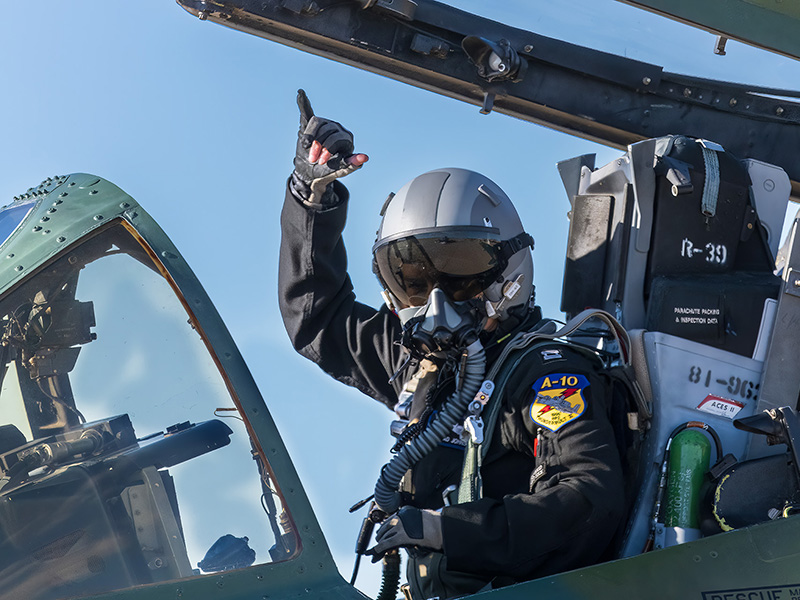
Meet The Pilot: Capt. Lindsay ‘MAD’ Johnson of the A-10 Demo Team
MAY 03, 2023
Capt. Lindsay “Mad” Johnson is no stranger to the skies. From flying in her dad’s CESSNA at 9 years old to jumping with “Wings of Blue” at the Air Force Academy, flying has been a core foundation in the life of the A-10 Demo Team’s newest commander.
Capt. Johnson entered the military as a Second Lieutenant in 2014 after receiving her commission from the United States Air Force Academy. Since then, she has served in Texas, Korea, and Arizona, amassing over 1,250 flight hours — including 431 combat flight hours– in the T-38 and the A-10C.
Now, after serving as Maj. Haden “Gator” Fullam’s safety observer the past two seasons, Johnson will take the helm of the A-10 Demo Team, performing at air shows across the country with fellow USAF Demo Teams and the Air Force Heritage Flight Foundation.
We sat down with “Mad” ahead of the 2023 Heritage Flight Training Course (HFTC) to learn more about her path to the A-10 Demo Team, training with legendary pilot Rob Holland, and spending just as much time jumping out of planes as flying them.
What does it mean to you to assume the role of A-10 Demo Team commander?
It’s huge. I’ve had an awesome opportunity over the past few years to serve as Gator’s safety observer as he’s been in the commander role. And while I’m excited to go out there and perform and inspire others to take on a role in the United States military, I’m most looking forward to the opportunity to lead this group of 12 individuals. The A-10 Demo Team is pretty unique in that we have three dedicated aircraft, so I’m excited to see our team operate and have the chance to lead and show people what the military is about.
Can you walk us through some of the more unique aspects of your HFTC training?
Fortunately, “Gator” has done a great job preparing me for Training Course. Even though it’ll be a bit different flying with a P-51 or F-35, he and I conducted several training exercises where I flew his wing through the training profile and then vice versa.
Once we get to Training Course, we have a syllabus that is dictated by Air Combat Command, and then I’ll do a backseat ride in the P-51 and, potentially also in the F-16 while “Rebel” does her demo. I was fortunate to get a backseat ride while working HFTC last year, but I’m hoping to get another one now that I’m in this role.
What are some of the unique capabilities of the A-10 in combat? What makes this aircraft so special?
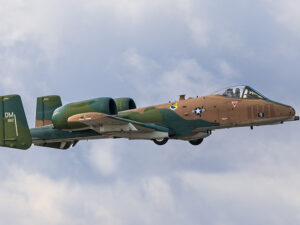
The whole airplane was designed around its gun – a 30mm Gatling gun – and if you look at the plane in person, you can see that the nose is offset because of how big the gun is. It is so big that it takes up from the front of the airplane all the way to the middle of the fuselage. This gun fires about 3,900 rounds per minute and 70 rounds per second, and it’s incredibly accurate. That “burst” is where the term “brrrrt” came from that a lot of people use when describing the A-10.
That is what we are well known for, but we also have roles in combat search and rescue (CSAR). We have also taken on the role of the Sandy mission, which stemmed from Vietnam because we [and the A-1] both have a platform that is beneficial for close air support as well as combat search and rescue.
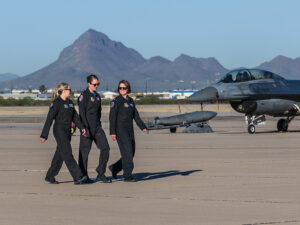
Knowing that female pilot representation in the Air Force has grown in recent years, what does it mean to you to be one of these women paving the way for future generations?
We certainly still have strides to make, but you know a lot of people will say “Hey, you’re really paving the way” when there were so many women before me that allowed me the opportunity to be here.
While it’s a big deal that I’m taking on this role, I’m proud that it’s becoming more common to see women in the cockpit. Hopefully, we get to the place where nobody even mentions [three female demo team pilots] because no one ever mentioned when it was three men.
It was gratifying during my time as safety observer at air shows with Gator to see the young girls and kids realize that I actually flew the aircraft too. I hope to take on the role as well as both “Beo” and “Rebel” have done and continue to make it seem like our role as demo pilots is the norm, not the exception.
Have you ever flown in a Warbird? Any aircraft still on your bucket list?
The P-51 Mustang is the only one I’ve had the opportunity to fly Warbird-wise, but I would love to fly in the back of a B-17 or a B-25 someday. There’s always the P-40 Warhawk too, which would be awesome.
Any notable personal anecdotes from your time to date in the skies?
This whole upgrade process for me has been a really memorable experience. Earlier this year, we got to go down to Louisiana to learn from Rob Holland. I got to know him a little bit during this second season with “Gator” as safety observer, and he’s both an incredible pilot and human being. He came down to Louisiana on his own dime to be there for our team, and he shared great insights and stories from his experiences.
Also, Kevin Coleman and his family have a hangar with some aircraft in downtown Shreveport, and they took each of us on the team to fly in the super decathlon while we were down there, which some colleagues noted was a cooler experience than when they went to the Super Bowl.
It meant a lot for [Rob] to take that time to help build my confidence in what I was doing. I’m sure there’ll be some really cool experiences that I get over the next two years, but that meant a lot to me that he and Kevin Coleman took the time out of their busy schedules and wanted to help us out.
You’ve always had a passion for flying, but what about the “Wings of Blue” Parachute Team inspired you to become a military pilot?
At the end of my junior year of high school, I had a pretty cool opportunity given my high school was right near Langley Air Force Base. One weekend we attended the Langley Air Force Base Air Show and got to witness the F-22 Demo Team. I distinctly remember watching that demo and being like “that was incredible.” We then watched the “Wings of Blue” jump into the air show at that exact moment. One of the jumpers that landed was a female, and I just remember being like “that’s cool. I want to do that.”
I had known I had wanted to fly long before that, but when I saw the “Wings of Blue,” I knew I had to apply to the [Air Force] Academy.
How does planning for a jump compare with planning a multi-ship demo flight? What have been some of the most difficult demo jumps you’ve performed?
The great thing about the “Wings of Blue” was that it was very much this step-by-step process. They don’t throw you into a four-way jump or a stadium if you don’t have the experience or the background for it. We would do everything from night jumps to prep for night games at the Academy to overwater jumps to get our sea license.
As far as prepping, we always had a formal briefing in the morning where everybody would talk about the weather, decide who was going to be the jumpmaster; and would go over emergency procedures
I was fortunate enough to jump into three home games for the football team at the Academy, which was fun because a lot of my friends and family were there. But what was always difficult about these jumps was accounting for the winds, which were really squirrely since the stadium was on the side of a mountain. The wind would always come off the mountains, and then as soon as you get into a stadium, the bowl effect would happen where the winds are shifting. To add to that, if the game is being filmed, you have to avoid the lines from all the cameras, the goalposts, videoboard, and all the people. Those were the more difficult ones, yet the most rewarding.
How has your experience as the Safety Observer prepared you for being on the other end of the demo?
It’s been cool to see things now from both perspectives. My job was to make sure that nothing was unsafe while “Gator” was in the air. It allowed me to see the things that I need to be aware of as a pilot and then relay that to my safety observer because there have been times where we’ve caught something that makes a difference. The big thing “Gator” reinforced was, “make sure you tell all of your safety observers that their job is very serious as they will most likely save your butt over the next year.”
Do you have a specific moment that sparked your passion for flying? Do you remember your very first flight?
I’d always had this military background from my dad, but up until my freshman year in high school I didn’t fully know that I wanted to join the military. When we lived in Georgia, I was about 9 years old, and my dad would take me up in his Cessna. I distinctly remember us flying around and getting to go fly over our house and see my brother and my mom outside.
This past year, we went to the Peachtree City Air Show, and as we were landing at Falcon field, I remember thinking this place looked really familiar. My parents drove up from Florida to meet us there, and my dad said, “This is where I kept my airplane. This is where you and I would go fly.” That was just a cool experience to go land the A-10 back to where it all kind of started for me.
Were there any pilots you looked up to that inspired you to pursue a career in military aviation, and why?
During my freshman year at USAFA I was fortunate that my Air Officer Commanding, Major Scott Poteet, who oversaw my small squadron of 100, was a former Thunderbird pilot and had just come from his Thunderbird assignment. He talked to us about that role and how important it was to learn from someone that did that job. I didn’t necessarily think I wanted to be a Thunderbird pilot, but I thought that the demo role was an incredible opportunity to help inspire young men and women across the country to join the military, whether that’s as a pilot, a maintainer, a public affairs officer or whatever they choose to be.
I also had a female T-38 instructor that used to fly A-10s, Lt Col Tammy Barlette, who has been my mentor through it all.
What advice have you received from other demo pilots? What would your advice be to young women aspiring to become pilots?
The biggest thing I’ve heard from “Gator,” “Cabo,” “Rebel,” and “Beo” is that whether you’re at Oshkosh with hundreds of thousands of people or a smaller air show where there are only a couple of thousand, you must treat every interaction with the utmost importance. Each of those is important, and just taking the time to stand next to a person that has some questions and tell them about your opportunity to get here always leaves an impact. I think we all have moments like that in our lives where a single interaction like that has been extremely influential.
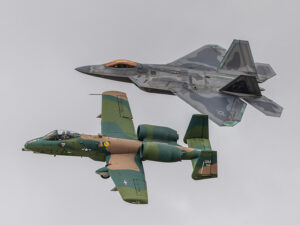
You overlapped at the Air Force Academy with the new F-22 demo pilot, Capt. Samuel “RaZZ” Larson, and were even part of The Academy’s jump team together. What will it be like to reconnect on the Heritage Flight team?
While we haven’t gotten to do any air shows together, we certainly had a lot of jumps together during our team trips over spring break, Thanksgiving and Christmas holidays. We got to do some fun stuff, and I think that training there allowed us good preparation for pilot training and our roles as demo team commanders. We jumped into air shows, football games, and golf tournaments, so it was a great learning experience in crowd interaction.
Can you tell us more about the handoff process from one demo pilot to the next? How did you work with “Gator” to ensure a smooth transition?
I’ve been super fortunate to have known “Gator” since we were stationed in Korea together in 2018. We then moved from that assignment to the operational squadron here at Davis-Monthan, and then continued working together in my previous role as his safety observer for the team.
Once I got selected, “Gator” and I went through extensive ground training; conducted several simulator events; and then we went through the whole training profile. Prior to my commander certification, “Gator” was my safety observer throughout this entire process, so he was the one on the ground talking to me through the radio with corrections and offering guidance from his valuable experience. Our last big section of training is three off-station training events – and as I mentioned earlier, we were lucky enough to go down to Louisiana and work with Rob Holland for my last off-station training sortie, which was an unforgettable experience.
Should fans expect any changes to the flight profile this year?
We have no major changes as far as how the profile will look this year, but we’re looking at potentially changing the order of the events for the 2024 season.
Photos by Larry Grace