MEET THE PILOT: MAJOR JOSHUA ‘CABO’ GUNDERSON
SEP 29, 2022
Major Joshua “Cabo” Gunderson, commander of the F-22 Demonstration Team in 2020, doesn’t remember a time when he didn’t want to fly jets. Since earning his wings in 2010, Maj. Gunderson has gained experience as a combat-proven fighter pilot with over 1,700 hours and two deployments to the Middle East.
Gunderson grew up in Tampa, Florida and attended the United States Air Force Academy, where during his time as a cadet he participated in a foreign exchange program at the Spanish Air Force Academy in San Javier, Spain. Following his graduation, Gunderson took part in the Euro-NATO Joint Jet Pilot training program and was assigned to the 44th Fighter Squadron at Kadena Air Base in Japan, and subsequently served in Alaska in the 90th Fighter Squadron.
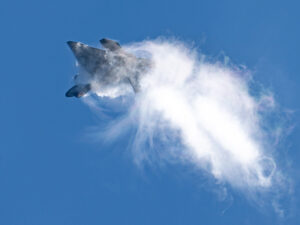
As commander of the Raptor demo team, Gunderson leads a 14-member squad that showcases the impressive performance and heritage of the F-22 fighter jet in formation alongside World War II, Korean and Vietnam-era aircraft at air shows across the country.
We caught up with “Cabo” to hear more about his military career, his mindset as a pilot and a full-circle moment as he prepares for the team’s upcoming demonstration at the California Capital Airshow in Sacramento.
Q: What first sparked your passion for flying? Do you remember your first flight?
A: I honestly don’t remember a time when I didn’t want to fly jets. From a very young age, this is what I’ve always wanted to do and my mom was very supportive. She always continued to push me towards it, and I’ve also been lucky to have had moments throughout my life that reaffirmed my pursuit of aviation.
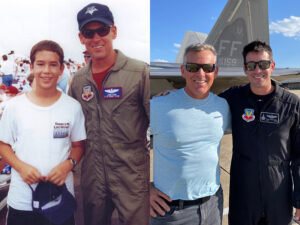
One of those moments was when I was 11 years old at an airshow at MacDill Air Force Base. I took a picture with the F-15C demo pilot at the time. Once I graduated from the Air Force Academy and went to the F-15C training course, I saw this pilot that looked familiar. I saw him again in the squadron with a helmet bag that had a West Coast Demo Team patch, thinking there was no way it could be the same pilot I met 12 years earlier. I called my mom to ask if she had that picture of me at the MacDill air show, which she found and sent to me, and sure enough, it was the same pilot! I ended up approaching him and telling him the story. It was such a full circle moment, and now as a demo pilot myself I’m hoping to keep that same cycle going for other kids. It’s cool to think that maybe in 20 years I’ll meet a pilot who met me at an air show when they were younger.
Q: What drew you to military aviation and inspired you to apply to the Air Force Academy?
A: Who doesn’t want to go fast or upside down?! That’s always awesome. I read a lot of books as a kid about World Wars I and II and the evolution of air combat, and to me, it was very appealing. From a very young age, I knew I wanted to serve in the military, and the Air Force just made sense since I wanted to fly and I wanted to serve my country. The Air Force has the best jets, and if you want the widest spectrum of aircraft, it’s the place to go. The Air Force Academy opened so many doors for me and offered opportunities I couldn’t get at any other university. In terms of percentages, your highest chance of attending pilot training is to go through the Academy.
Q: What was it like having spent time with the Spanish Air Force on a foreign exchange program as a cadet at the Air Force Academy? What are some learnings that you brought back with you to your Air Force career?
A: A lot of things are very similar especially as it relates to the core fundamentals of the military, regardless of the country you’re in. We’re a force volunteering to serve our fellow citizens and our nation, and if called upon we go do that job. There’s a high level of discipline and conformity because no matter what you’re doing in the military, everything is done as a team.
Q: Can you walk us through some of the more unique aspects of your F-22 Demo Team training? What are some of the most difficult parts of flying alongside warbirds?
A: We have very few maneuvers that are airshow specific; we practice the maneuvers that we would do in combat to showcase the capabilities of the F-22. The focus of the training is to take the maneuvers, refine them and give them very specific parameters to make sure they’re safe for the crowds and can be replicated. The program shares the knowledge I have with my successor to make sure we fly safe demonstrations and to make it look awesome for the crowds. We hopefully leave them with a memorable experience. What’s cool about our shows is that we time everything, so the music changes based on each locale. The soundtrack for a show in Texas is going to be very different from one in Miami, for example. It’s all synchronized down to the exact second.
In terms of Heritage Flight training, it was awesome. I got to fly with Steve Hinton on my very first training flight, who is one of the most experienced warbird pilots in the world. I was starstruck by the aircraft and by Steve. Thankfully the F-22 has big wings and state-of-the-art flight control services, so flying it slow with the warbirds isn’t too much of a challenge for us.
Q: Of all the aircraft you’ve piloted, which is your favorite to fly and why?
A: I think for me I would break it down into military and civilian aviation. On the military side, I’m torn between the F-15 Eagle and the F-22 Raptor. The F-15 was the airplane I knew as a kid that I wanted to fly; it just represents America to me. When I look at the F-15, I look at it like a 1970s muscle car. You are directly connected with the flight control system. The F-22 is more governed on the flight controls, so it’s more like a brand-new sports car. The F-22 is the airplane I’ve been deployed with, and ultimately, it’s the one I’d choose 10 out of 10 times when it comes to combat. On the civilian side, there’s nothing better than flying in a Bush plane like the Super Cub or Aviat Husky with the windows down, feeling the breeze and enjoying nature around you.
Q: What are some of the similarities and differences between the F-15C and F-22? What makes the F-22 so special?
A: The F-22 replaced the F-15 in the air-to-air fighter role, but the F-15 was the best airplane for that for a long period of time. In terms of records, it’s the most successful airplane in history. The F-22 took 20 to 30 years of technological advancements, including its stealth platform that makes it very difficult to be seen on radar. The F-22 is about 90 percent offense and 10 percent defense, which allows us to operate in areas other aircraft can’t.
In terms of performance, being a stealthy airplane, we carry all our weapons inside the airplane. Not only does it keep us stealthy, but it reduces drag, making the engines more powerful and the acceleration much more pronounced so you can go higher and faster. The flight controls are phenomenal too, allowing the airplane to be completely controllable even in stalled states. The other thing that makes the F-22 unique from the F-15 is that it has fully integrated sensors and avionics, with sensors all around the plane that feed into the cockpit so you can make your decisions faster. It’s an absolute joy to fly for a lot of reasons.
Q: Have you ever flown in a warbird? Any aircraft still on your bucket list?
A: I flew the Mustang “Bum Steer” as part of our Heritage Flight training. If we’re talking about iconic World War II airplanes, the P-51 Mustang is it. It is a beautiful airplane. To fly an iconic airplane like the Mustang is awesome and you can’t put words to it. In terms of my bucket list, if I were to pick any other fighter jet to fly right now, it would be the A-10. The A-10 is a single-purpose airplane and is designed to do close air support better than any other plane in the world. Some people like multi-role aircraft, but for me, I like being focused on one thing and being the absolute best at that, which I can do in the F-22, and the A-10 embodies that as well.
Q: Any notable personal anecdotes about your most memorable flight?
A: I remember one of my first moments flying fighter jets that sticks with me was a high-aspect BFM ride in Klamath Falls, Oregon. High-aspect BFM is where you essentially start in neutral with basic dogfighting maneuvers. You start off offensive behind the person you’re fighting, and with high aspect you meet in the middle, so no one has an advantage. My high-aspect ride in Oregon was with the highest-timed F-15 pilot in the Air Force at the time. No one had more flying hours in the F-15 than this pilot, and I probably had the least. During the dogfight, we got into a tree, which means that we’re going very slow and we’re fighting for who’s pushing forward and who’s pushing back. It was timed at sunset, so we had this amazing red and orange glow from the afterburners, and it was one of those images I’ll never forget.
Q: What aviators did you look up to as you started your career and why?
A: Bob Hoover was an amazing pilot, and he brought aviation to so many people in a cool and exciting way. On the military side, you can’t go wrong with Robin Olds. He’s an icon, especially in fighter aviation. Anyone that goes into fighter aviation with the attitude that they might not win has already lost. You have to be confident in what you’re doing, and use the airplane as an extension of yourself, and there are very few people who embody that mindset better than Robin Olds.
Q: What’s the best advice you’ve received that you’d like to pass along to aspiring aviators?
A: Don’t quit. If you’ve never run a marathon before but want to run a marathon, you don’t tackle it all at once. Just put one foot in front of the other foot until you get to the 26.2 miles. It’s very easy to get overwhelmed with the immensity of what you’re trying to achieve, whether that’s being a fighter pilot or a doctor or another profession, so just focus on the next task. I had a picture of the F-15 in my room as a kid, and I pictured the Air Force Academy. Every morning when I woke up, I saw that goal. I was constantly reminded of how I spent my time and if I was getting closer to my ambitions or not. It’s all about how you spend your time and whether it’s spent in pursuit of your objectives or not.
Nowadays we’re inundated with so many things, so when you think about your goals, you must put the distractions away and focus. There are plenty of people or things in this world that are going to try to stop you, but if you have the tenacity and grit to go after your goals, it’s not going to matter what obstacle or hurdle may be in front of you. My family emigrated here from Cuba in 1966, and they started with nothing, but they just had that mindset that they would keep working hard no matter what, so I owe that mindset to them.
Q: What does it mean to you to have been named commander of the F-22 Demonstration Team?
A: It’s an absolute privilege and honor to be able to do this. Being able to pay it forward to future generations of people that are interested in aviation or the military is very impactful. The flying is cool, don’t get me wrong, but that’s maybe 20% of what I do. I look at this airplane as a way to show people that you can have goals and aspirations, and if you want to achieve them, find the things that make you excited. On the team side, we work with the best people in the world. We get to fly around the world, do these shows and talk to kids, but having the family dynamic we have is an added bonus. The people are the thing I enjoy the most about this job.