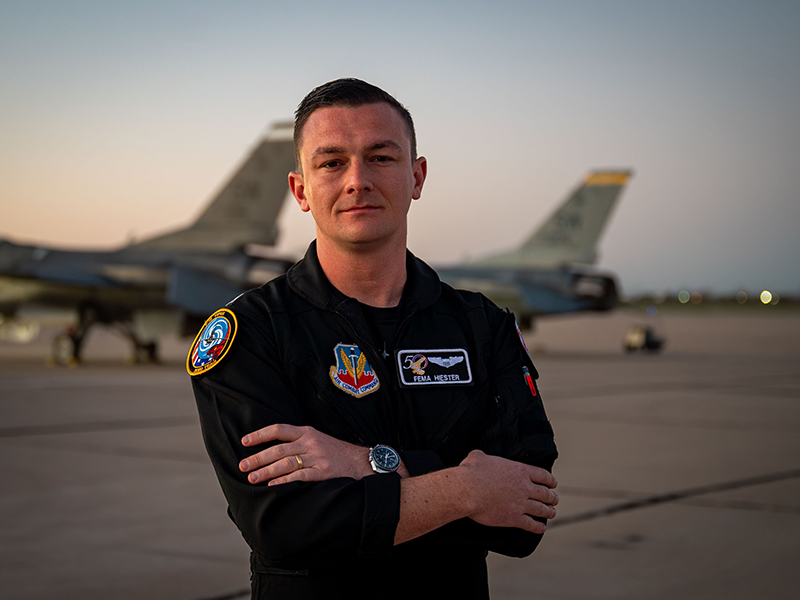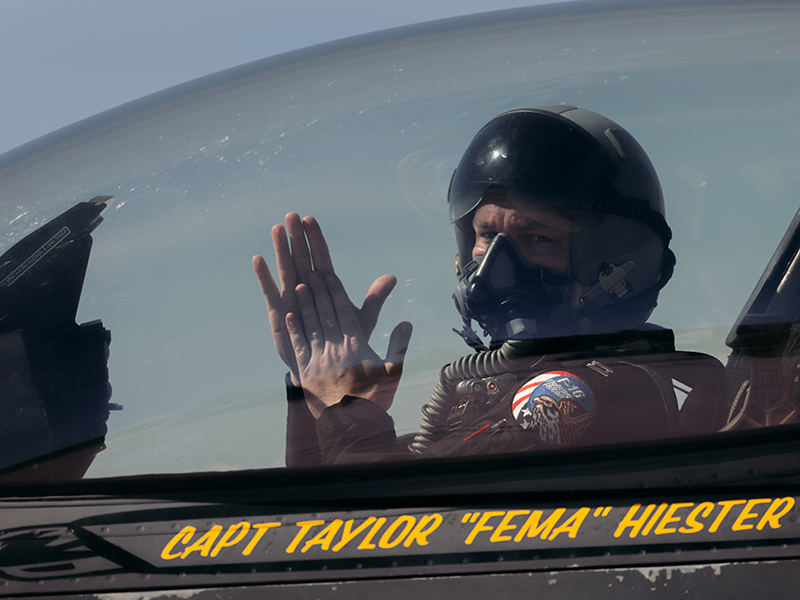
Meet the Pilot: F-16 Demo Team Commander Taylor ‘FEMA’ Hiester
March 21, 2024
Like every kid, Capt. Taylor “FEMA” Hiester had an airplane phase, but he never grew out of it. Capt. Hiester always knew he wanted to be an American fighter pilot and fly the F-16. From ROTC at Penn State University to flight training at Holloman Air Force Base, that drive and personal mission to serve his country led Capt. Hiester to his new role as commander of the F-16 Viper Demo Team. Now he will travel to over 25 airshows this year, performing for millions of Americans, and celebrating the landmark 50th Anniversary of the F-16.
We sat down with “FEMA” ahead of the 2024 Heritage Flight Training Course (HFTC) to learn more about his love for the Apollo era, his unique connection to Heritage Flight pilot Jim Beasley Jr., and his passion and pride for American aviation and innovation.
Q. What first sparked your love of aviation?
A. When I was a kid, I was driven by a sense of exploration and adventure. If it was meant to take you somewhere else, it captured my imagination. . I went through a lot of the standard phases that children do and when I got to the airplane phase, I just never grew out of it. I don’t remember a day in my life wanting to be anything other than an American fighter pilot and even now, I still work for it everyday because it’s a way of life that has to be defended. It’s so much more than a title to me. There’s an old saying – “There are fighter pilots and then there are people who happen to fly fighters.” Even on days where I’m performing at my best in the jet where I might be doing some very “fighter pilot esque” things, I’m uncomfortable calling myself a fighter pilot because there’s always tomorrow and that’s the sortie that matters. I’ll work on being the best fighter pilot I can long after they make me hang up the flight suit for the last time. It’s a way of life.
Q. What first drew you to flying the F-16?
A. I’ve always had a unique desire to fly the F-16. To me, it’s the perfect fighter jet. It’s got smooth lines and this great big bubble canopy on the front so it feels like you’re putting on this backpack as opposed to sitting in an airplane. You really become one with it.
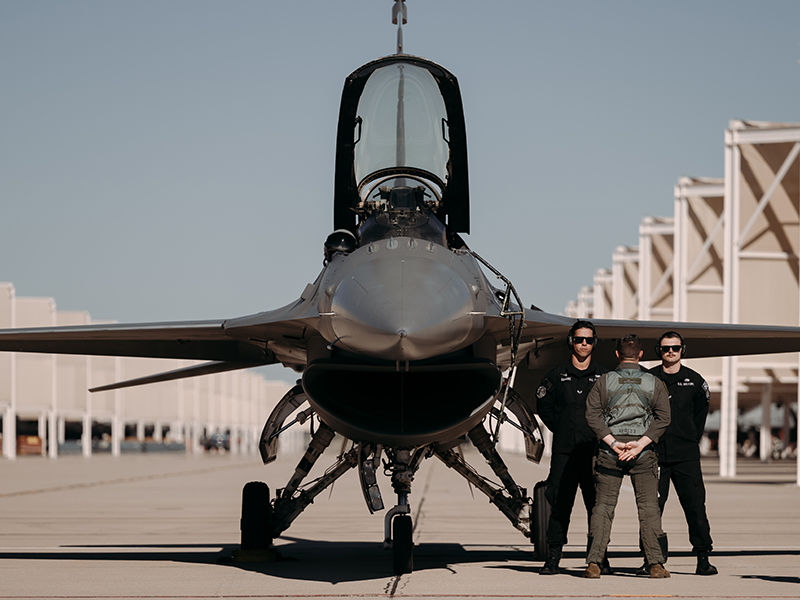
One thing that I always speak to about the F-16 is the capabilities of the aircraft. Within just a few minutes of each other, I can be just shy of Mach 2 at 50,000 feet in the sky, seeing the curvature of the Earth, to then being 500 feet in the air going 500+ knots. The fact that this airplane can go from one extreme to another within a few minutes is such a testament to the innovation and success of American technology.
It’s been a dream come true to fly the F-16, and every time I walk up to the aircraft I remember how thankful I am to have this opportunity to fly. This year we are celebrating the 50th Anniversary of the F-16, so it’s really special to be part of this team during such an incredible milestone.
Q. Can you walk us through the decision to join the Air Force Heritage Flight Team this year?
A. I’ve always had this fascination with performance and engineering in aviation, so the opportunity to work with the Heritage Flight program is this once in a lifetime chance to fly with airplanes that are so integral to American history, like the P-51 Mustang.
Q. Have you ever flown in a Warbird? If so, which one(s)?
A. Last year, when I was serving as the safety pilot of the team, I had the chance to give a few rides in the F-16 to several deserving airmen and civilians in Tucson, Arizona.
During that week, I had the honor of flying in P-51 Mustang “Double Trouble Two” with Heritage Flight Pilot Greg “B.A.” Anders. It was my first warbird experience, and it was a big contrast to my flights in the F-16. I never quite realized how much personality the Mustangs have; each one pops and cracks, the wind is in your hair and the aircraft even shakes when the motor is idling. Believe me if anything is shaking or the wind is in your hair in the F-16, it’s a big problem and cause for some excitement.
I think the part that will stick with me the most is that the Mustang and the F-16 were only built 30 years apart, which sounds like a long time on paper, but I’m only 30 years old and time seems to be flying by. It’s just amazing to marvel at the advancements in American engineering and technology in the past half century.
Q. Are any aircraft still on your bucket list?
A. If I could take one airplane around the block, it would be the SR-71 Blackbird. It reaches back to that sense of exploration and fascination with adventure and performance I’ve always had.
Q. Were there any pilots you looked up to that inspired you to pursue a career in military aviation?
A. During my time in the ROTC at Penn State, a friend of mine connected me to his classmate John Martel because he knew I wanted to be a fighter pilot. John and I stayed in touch throughout my journey in ROTC, and then when I was selected to fly the F-16, John was stationed at Holloman Air Force Base, where our fighter training courses took place. So close to 10 years after we first spoke, a fellow Penn Stater, and role model of mine was stationed at the same base where I would begin my journey to becoming an F-16 pilot.
John ended up flying in the backseat in my very first F-16 flight and the first time I went supersonic. It’s hard to put into words how special that experience was for me. He was stationed at Holloman for the entire year I was training, so it was only fitting that my last flight at base was also with him.
Even now when I’m preparing for the F-16 Demo, I’ll go back and watch a bunch of old videos of Snort Snodgrass flying the TOMCAT demonstration to see what I can learn, not only from his flight profile but also how he interacted with the crowd, displayed excellent showmanship, and served as that inspiration for so many. No one flew a photo pass like Snort. Nobody.
Q. Back in 2017, you had the unique opportunity to fly in formation with two other Penn State alumni. How has this special network of alumni helped shape your experience in the military and as a pilot?
A. Penn State probably has one of the most connected aviation alumni networks of its kind. Every place I’ve been, from flight training to Shaw Air Force Base, there has been a Penn Stater there. The chance to fly with so many of them is special. I hope to be able to participate in a flyover there one day, especially with several other alumni.
Q. In this new role as a leader of the Viper Demo Team, how do you hope to inspire and educate future pilots and aviators?
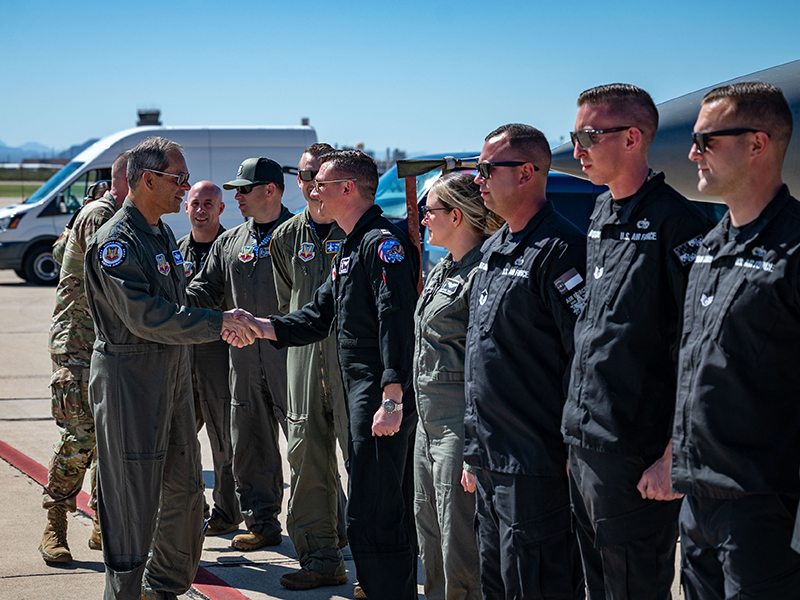
A. As a small team of 10, the mission of the Viper Demo Team is to inspire every American that we meet. We work as hard as we can to be something that both young and older Americans can point to and be proud of.
I’ve had the opportunity to speak at a lot of schools and youth programs. We get a lot of the same questions like how fast we can go, how we go to the bathroom in the airplane. I’ll often get the question about how someone can grow up to become a fighter pilot and I prefer to use that time to deliver a more important message. It would be amazing if every young person I talk to grew up to achieve their lifelong dream. Maybe they want to be an astronaut, fighter pilot, a surgeon or scientist. But wouldn’t it be even more amazing if each and every young person we talk to grew up to be happy and to love themselves for who they are? Our team must be an example of what happens when you dedicate your life to something bigger than yourself and lose yourself in service to your community whether that is big or small. When you set goals and make them known, it forces you to be honest about what your priorities are and my hope is that young people can find inspiration in our team not just for the work that we do but who we are as real humans with real feelings.
Q. How did you work with Capt. Aimee “Rebel” Fiedler to ensure a smooth transition, and should fans expect any changes to the flight profile this year?
A. Something that’s unique about becoming an Air Force demo pilot is that the cadre of people that are qualified to teach you is exactly one. So that is something that’s unlike any other job that I’ve had so far.
When I started training, I rode in the backseat with Rebel for a flight and it rolled my socks down. I couldn’t believe how aggressive the demonstration was; it looks way different from the ground than it feels in the air, and I loved every moment of it.
After that, I’ve spent a lot of time in the front seat, which was a lot of pressure given that Rebel has been the demo pilot for the last couple of years and performed that flight profile over a thousand times. She and I have been working together a lot to not only make sure the demo looks good, but most importantly that it’s safe for us, our crew, and our audiences.
Without a doubt, my favorite part of training and the handoff process has been working together with our small team to get everything ready for this season. The average spectator might think that there are dozens of people that are working to make our flights happen every week, but that’s simply not true. My training as a pilot is just a small part of everything that the team is doing right now.
Not only are the maintainers and public affairs team doing their primary job at every airshow, but they do so much more. I trust each of my maintainers with my life in a daring demonstration, and then our public affairs lead is tasked with making sure our message reaches the millions of Americans we interact with at airshows all season. It’s a challenge and honor this team is well equipped for, and I couldn’t be prouder.
As far as changes to the flight profile, our audiences should expect some fresh flying because even though we are performing the same maneuvers, each can look and sound a bit different from pilot to pilot. We also have a new soundtrack this year, and I think everyone will be really excited about it.
Q. What are you most looking forward to as a new member of the AFHFF program? At Heritage Flight Training Course?
A. I spent almost my entire life learning about many of these planes we’ll see at Heritage Flight Training Course in history books, but it’s a totally different experience seeing them in a museum or on a ramp than seeing them in action.
Even in the hard moments of training, I’m so grateful for the once-in-a-lifetime opportunity to learn from these pilots that have been doing this for a long time like Jim Beasley Jr.
I grew up going to the Mid Atlantic Air Museum in Reading, PA, and it’s always had a special place in my heart. My wife and I actually got engaged at the museum, and we still take our son there whenever we can.
The museum hosts an annual World War II weekend, which brings over 80 warbirds to the area, and I will always remember, even from a young age, getting to watch Jim fly at the show year in and year out.
To have the opportunity to share the sky with someone I grew up watching is something I still can’t quite put into words. To me, that is the embodiment of this program and why we train for Heritage Flights.
Q. To your future generations reading this one day, what’s one thing you’d like to be remembered for in your aviation career?
A. I would say that I would want to be remembered as a man that lived his life in service to the country rather than himself. America is a 250-year-old good idea that we have to work on and defend every single day. For my son, especially when he gets older, I’d like for him to remember me and think of me that way.
If I have the chance to meet a couple million Americans on the road over the next few years and even just a handful of them to remember me as somebody who served the country, I think that would be valuable to me. This job and the story of how I was fortunate enough to grow up with a dream and achieve it doesn’t belong to me. It belongs to America.
Q. What is your favorite aviation movie?
A. I know that it’s not strictly an aviation movie, but I have to say “Apollo 13.”
I would consider myself an Apollo nerd, and that era of exploration and aviation has always been inspiring to me. The fact that in the early 1960s President Kennedy challenged the country to go to the moon before the end of the decade and then we did – even with computers the size of school buses and the unimaginable challenge of developing this technology.
I actually had the chance at ICAS this past year to speak with Greg “B.A.” Anders about his father, Major General Bill Anders, and his experience on the Apollo 8 team. It was a dream come true and “pinch me” moment to hear his personal stories about his father as both the man and the aviator.