Meet The Pilot: Capt. Samuel ‘RAZZ’ Larson
FEB 28, 2023
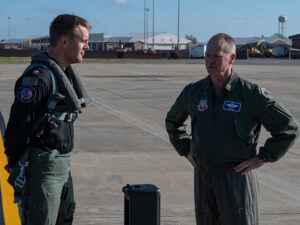
Having attended his first airshow at just 6 months old, Capt. Samuel “RaZZ” Larson has been captivated by the military’s demonstration teams for as long as he can remember. Now an experienced fighter pilot, Larson is looking forward to joining that community himself by taking on a new role as commander and pilot of the F-22 Demonstration Team for the 2023 air show season.
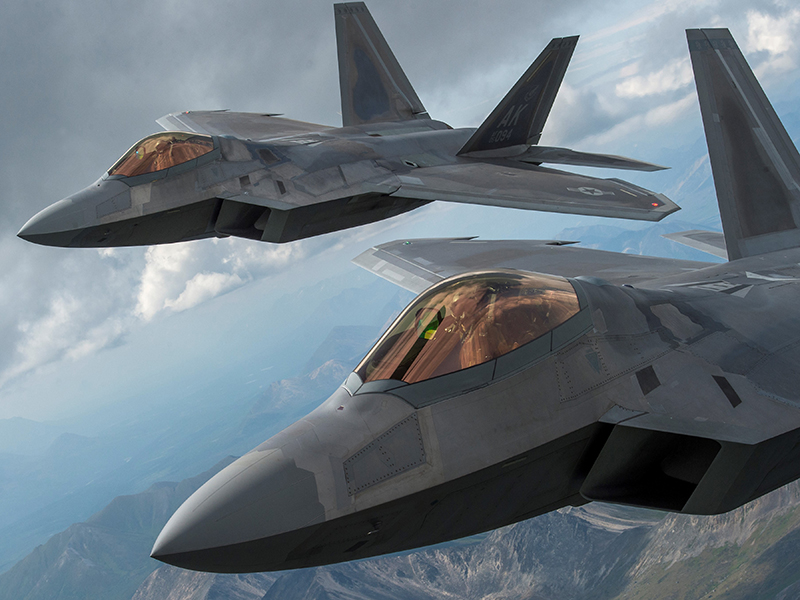
Larson grew up in Davenport, Iowa, and graduated from the U.S. Air Force Academy in 2015, where he also spent time as a parachute instructor and participated in approximately 700 freefall skydives before earning his wings. With more than 750 flying hours in the Raptor, Larson leads the 14-member F-22 Demonstration Team that showcases the capabilities of one of the Air Force’s most advanced fighter jets through its unique combination of stealth, speed, and agility.
We sat down with “RaZZ” ahead of this year’s Heritage Flight Training Course to learn more about his love for aviation, his military career and what he is most looking forward to as a new member of the Heritage Flight program.
______
Q: Can you walk us through the decision to join the F-22 Raptor Demo and the Air Force Heritage Flight teams this year?
A: Air shows and demo flights were what first sparked my interest in aviation. I don’t have any aviation or military background in my family, but I grew up near the Davenport Municipal Airport that hosts the Quad City Air Show every year. I went to the show every summer, with my first one being at 6 months old. Eventually, I was able to meet the pilots from the demo teams, which was when I set my sights on becoming a pilot myself. The demo pilots set an example I wanted to emulate, and I thought it was a noble goal to serve your country while being a fighter pilot.
Ever since a young age I’ve loved all facets of aviation, and I especially took a liking to warbirds. When I was a teenager, I started working for an airshow magazine called World Airshow News and got a lot of cool opportunities to go to airshows and fly with performers. I had the opportunity to fly in a T-6 Texan and fly in formation with a P-51 and a P-40 from Fagen Fighters WWII Museum, so it’s been something I’ve loved my whole life. I went to the Air Force Academy and started flying Raptors, and ever since I’ve wanted to get back into the demo world and pay forward the inspiration I received when I was younger.
Q: Can you walk us through some of the more unique aspects of your F-22 Demo Team training? What do preparation and practice look like?
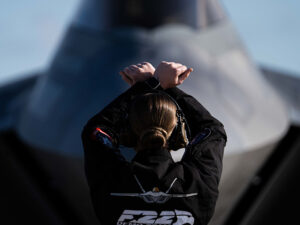
A: Upon my selection last spring, I joined the team on the road for the last half of the show season and then started flying on the days we were back at Langley. The training is comprised of about 20 flights practicing the demo. You practice the demo with an artificial floor over the water and then you gradually step down in altitude to start while flying the demos over Langley, all with the previous demo pilot as your instructor from the ground. Josh “Cabo” Gunderson taught me, and I couldn’t think of a better person to learn from. Since I completed certification in December, we’ve been flying local practices about two to three times a week to make the demo look the best it possibly can. We’ll continue practicing all the way up until the Heritage Flight Training Course and leading up to our first show.
Q: Can you tell us more about the handoff process from one demo pilot to the next? How did you work with “Cabo” to ensure a smooth transition, and should fans expect any changes to the flight profile this year?
A: I started off with “Cabo” teaching me the demo and flying a chase aircraft behind me for the first two sorties, and afterward he acted as Safety Observer from the ground. We also would debrief extensively, discussing the HUD tapes and ground footage after every flight. He did an amazing job of teaching me to fly the demo the right way: safely but also aggressively. There’s a lot that goes into this job beyond flying, especially with crowd interaction and how you lead the team. In terms of the logistical planning that goes with the demo, we are unique as the F-22 demo team in that we don’t own any of our own airplanes. We borrow combat-ready jets from any unit that’s close to the show, so there can be a lot of challenges that go along with that.
I’m thankful for the time I spent traveling with “Cabo” and the team, and I feel like we will be off to a great start with this upcoming season. As far as changes to the demo, we’re looking at some, but fans should not expect anything major, at least for now, given that major changes to our sequence are subject to a long approval process. We have an outstanding team assembled this year that represents the best of the Raptor community, and I’m excited for airshow goers to get to meet them this season.
Q: You have spent most of your career flying the F-22, having logged more than 750 flight hours. What specifically drew you to the F-22?
A: What drew me to the F-22 was seeing an airshow demo in 2015 right before I started pilot training. I knew I wanted to fly fighters but seeing the Raptor in action had a profound impact on me. All throughout pilot training, I would take time in the morning before I started coursework to envision myself being assigned to the F-22, which gave me a lot of motivation to work hard in all of our training events. I am extremely humbled and privileged to have the opportunity to fly the F-22.
As far as other aircraft I’d like to fly, I love fighter jets, so I’d fly any fighter if given the opportunity. But, if I had to do it all again, I would still choose the Raptor. I love the comradery and brotherhood of the F-22 community with our tight-knit squadrons and outstanding group of maintainers.
Q: Have you ever flown a Warbird? Are there any aircraft still on your bucket list?
A: Flying in the original T-6 Texan with the Aeroshell team was the closest I’ve gotten to fly in a warbird. I also was able to fly with Paul Wood from the Warbird Heritage Foundation in an L-39, and he played a major role in sparking my interest in warbirds. I love the P-38 Lightning, so getting to fly it would be a thrill, but I love warbirds so any of them would be awesome.
Q: You have also spent time as an instructor pilot and a parachute instructor. What spurred you to get involved on the instruction and training side, and how has that role helped prepare you for your own aviation career?
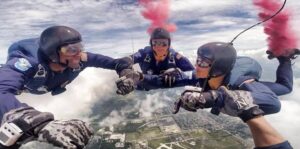
A: While I was at the Air Force Academy, I got to do about 700 skydives as part of the basic freefall parachutist program, where cadets and active military can receive a basic freefall parachute badge. The Academy uses it as an opportunity to prep future Air Force leaders and put them in an uncomfortable, stressful situation that demands you to step up. I was a parachute instructor following my completion of the program and was upgraded to a jump master. That was great prep for me as a cadet prior to my active-duty career because it gave me the opportunity to learn how to teach effectively. I learned a great deal from all of my instructors throughout pilot training and my time in the F-22 who invested time and effort into training me. You learn a lot along the way as an instructor, and I’m very fortunate and thankful to have been given those opportunities to instruct.
Q: Any notable personal anecdotes from your time to date in the skies?
A: During my three years stationed in Alaska, I was able to be a flight lead on a mission where we intercepted Russian bombers and fighters. After we intercepted them, we passed through Denali National Park on the way home. We were flying low-level through the park in the F-22 all around the mountains, lakes and glaciers in the late summer daylight, so the backdrop was gorgeous. It was one of those flights that you dream about when you’re hoping to become a pilot.
Q: Do you have a specific moment that sparked your passion for flying? Were there any specific planes that captured your imagination as a child?
A: When I was younger, some of the F-16 Viper Demo Team members gave me the opportunity to sit in the cockpit, and at the time it was like I had won the Super Bowl. I was beside myself with joy, but it was also very reaffirming for me that becoming a fighter pilot was what I wanted to do. I also got to meet Brig. General Regis Urschler and he let me see the cockpit of a P-51 Gunfighter. He taught me all about the importance and significance of keeping warbirds flying, and that was where my passion for warbirds began.
Q: Were there any pilots you looked up to that inspired you to pursue a career in military aviation, and why?
A: I could go down a list of all the ACC and demo pilots from the late 90s throughout the 2000s. I got to meet many of them and they had a profound impact on me. Without the example they set and their words of wisdom, I would not be here getting to do this job today. I was also able to meet legends like Jim LeRoy, Jimmy Franklin and Bobby Younkin at my hometown airshows, which sparked an interest for me beyond just military aviation.
Q: What are you most looking forward to as a new member of the AFHFF program?
A: Flying in Heritage Flights is by far the thing I’m looking forward to the most, but also getting to be a part of the Heritage Flight community. Flying the demo is great, but as an active-duty Air Force pilot, getting to fly with such amazing warbirds is the most unique aspect of what we get to do. Members of the Heritage Flight program dedicate their time, money and efforts to honor those who came before us and keep this history alive for the next generation. I’m thrilled to be on the team and work alongside such great Americans who recognize the importance of Warbirds and what they represent.