Air Force Heritage Flight Foundation Officially Welcomes F-5 Tiger To Program
MAR 07, 2023
Air Force Heritage Flight Foundation is excited to announce the newest addition to the program’s aircraft lineup – the F-5E Tiger. As an integral part of the United States Air Force’s elite aggressor program, the F-5 was instrumental in training some of the most successful and decorated pilots in the modern era. Its unique history both as a combat fighter and trainer makes it a first-of-its-kind addition to the Air Force Heritage Flight Foundation with an even more important story to share.
Developed by Northrop in the 1960s, this supersonic light fighter was an offshoot of the manufacturer’s well-known trainer, the T-38 Talon, as a way to leverage the Talon’s immense success and transform it into a single-seat fighter.
In addition to equipping the F-5 with more powerful engines and hardpoints on the wings for additional armaments, Northrop also outfitted the aircraft with cannons, gun sights, radar, a drag chute, and installed an air refueling probe that were vital to its combat capabilities.
To test the Tigers’ proficiency, in 1965 the United States Air Force established Skoshi Tiger(“Little Tiger”), an evaluation program where the F-5 flew missions across Southeast Asia alongside F-4 Phantoms and F-100 Super Sabres. Twelve aircraft were delivered to the 4503rd Tactical Squadron and designated as F-5Cs following additional modifications. Over the course of six months, these aircraft flew more than 2,600 sorties over South Vietnam and Laos.
Nine aircraft were lost due to enemy fire and operational issues, but the program was considered a success, thoroughly cementing the F-5 as a legitimate and capable fighter. And while the USAF didn’t have the capacity to logistically support another aircraft type at the time, Northop was able to attract many foreign buyers who were looking for reliable, less expensive aircraft to defend their nations. Some of these foreign militaries include Switzerland, Norway, Mexico and Brazil.
While its involvement in South Vietnam and the Skoshi Tiger program are key to the F-5’s history, its role as an aggressor for pilot training solidified its legacy in American aviation.
Because the F-5 so closely resembled the Soviet MiG 21 that was flown by America’s adversaries, it was tapped by the USAF to train fighter pilots for aerial combat. Those selected for the aggressor program were considered experts in their field. They meticulously studied Soviet threat systems; deployed these tactics against their peers in flight every day; and even adorned their F-5 aircraft in various Soviet paint schemes and mixed markings.
While the F-5 aggressors might not have been as advanced as the F-15s or F-16s, their maneuverability and size made them difficult adversaries and kept American pilots prepared for potential combat.
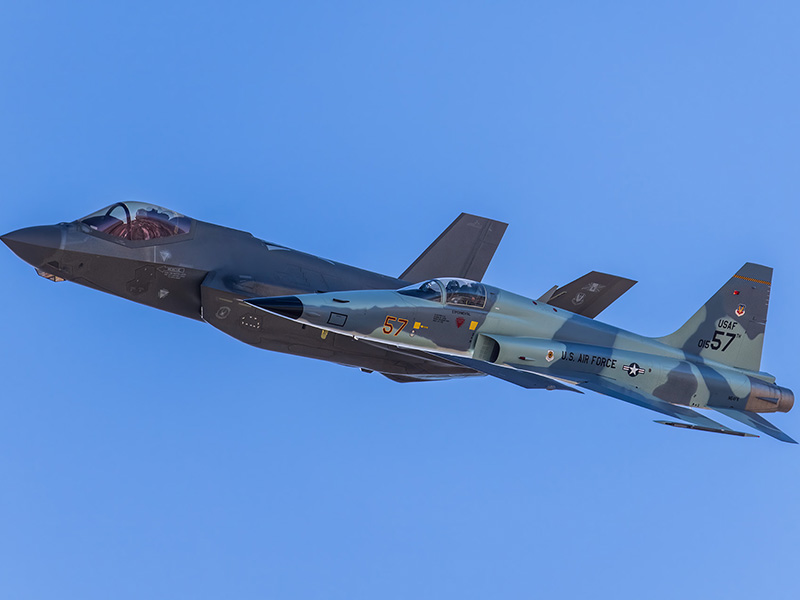
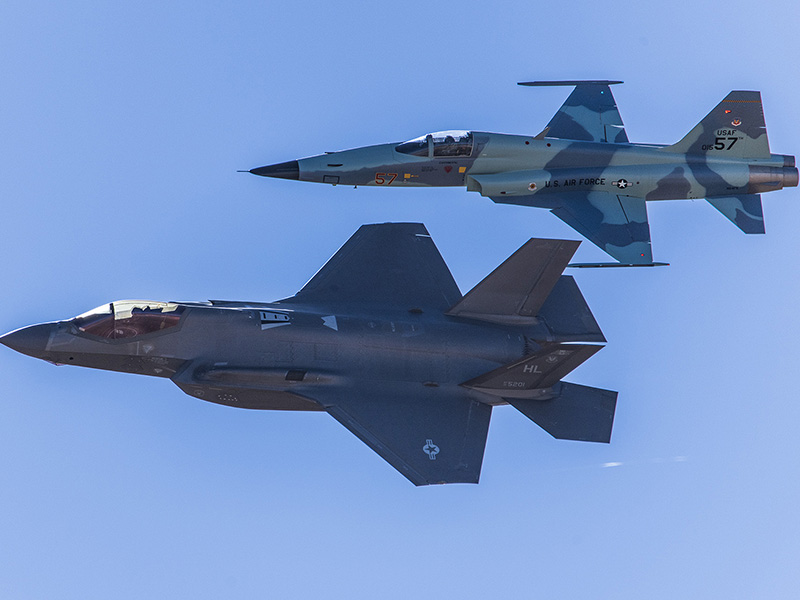
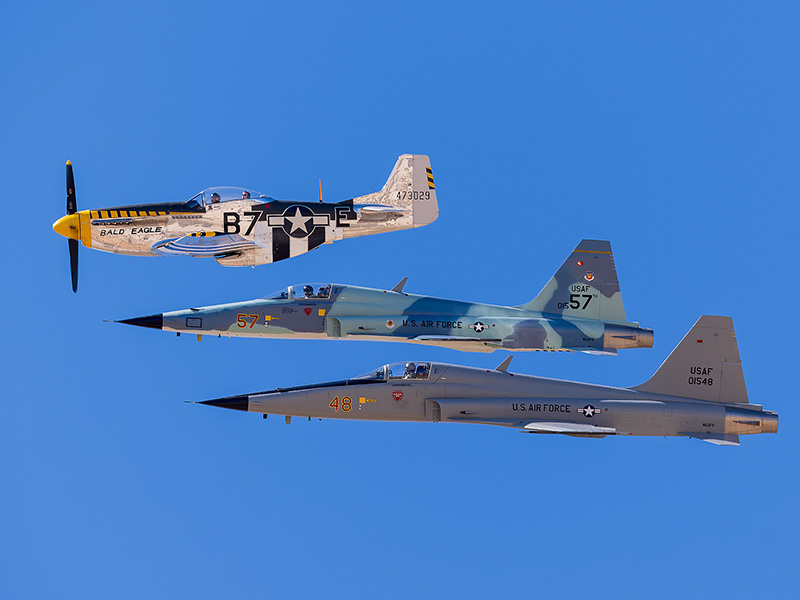
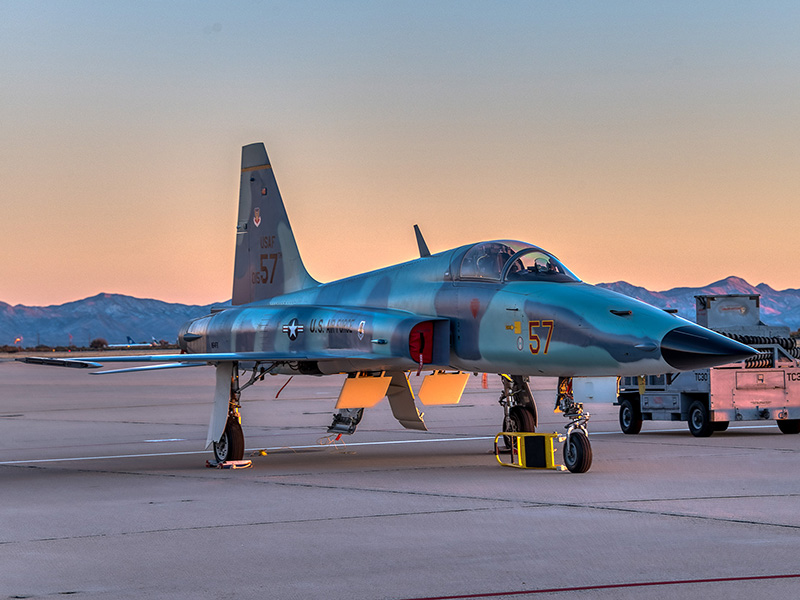
Of the two F-5s joining the Air Force Heritage Flight program this year, one will be adorned in the scheme of the Wing Commander for the 57th Fighter Weapons Wing, the aggressor program at Nellis Air Force Base in Nevada. As the Wing Commander, this pilot would have had his own jet with special markings that symbolized his role within the air fleet.
In addition to the markings of the 57th, the Heritage Flight F-5 features the blue aerial camouflage scheme that was a hallmark of Soviet-era fighters and was meant to help hide the aircraft in the sky.
Those lucky enough to see the F-5 in action this year should expect a high-octane performance. Typical Heritage Flight missions with the P-51 Mustang are flown at around 200 to 250 knots. However, the capabilities of the F-5 will allow for a much faster show with more vertical elements.
It will also be a great opportunity for fans to learn more about the F-5’s unique history and witness the USAF Demo Teams flying alongside one of the most influential aircraft of the jet era.
Fast Facts:
- Date Deployed: 1964
- Maximum Speed: Mach 1.68
- Service ceiling: 50,000 ft
- Range: 2,314 miles
- Span: 26 ft, 8 in
- Length: 47 ft, 5 in
- Height: 13 ft, 4 in.
- Weight: 24,722 lbs (maximum takeoff weight)