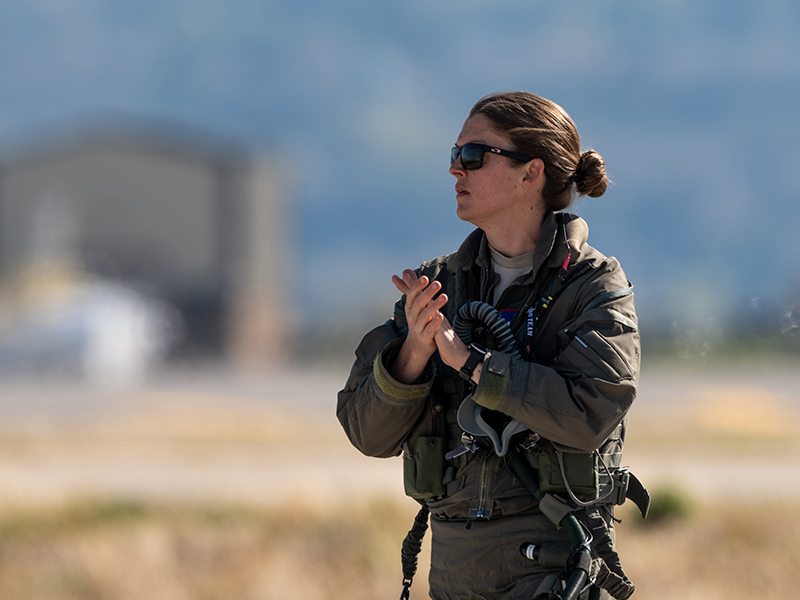
MEET THE PILOT: MAJOR KRISTIN ‘BEO’ WOLFE
NOV 30, 2022
F-35 Demo Team commander Major Kristin “Beo” Wolfe followed in her father’s footsteps by pursuing a career in the Air Force, but is now establishing her own legacy in the cockpit of America’s most advanced fighters. As a senior pilot with more than 1,000 flight hours, Maj. Wolfe has gained experience flying a variety of aircraft including the T-6, T-38C, F-22A and F-35A.
Maj. Wolfe entered the military in 2011 after receiving her commission from the Air Force ROTC program at the University of Alabama. She is currently stationed at Hill Air Force Base in Utah following fighter training and operational assignments across Texas, Florida and Virginia.
As commander of the F-35 Demo Team, Wolfe oversees a crew that showcases the unique aerial capabilities of the Air Force’s flagship fifth-generation fighter and the legacy that led to this technological marvel.
We sat down with “Beo” to learn more about her military upbringing, her journey to military aviation, the unique capabilities of the F-35 and more following the Demo Team’s final flight of the season at Nellis Air Force Base.
Q: What first sparked your passion for flying? Do you remember your first flight?
A: I had a bit of a different path from people who knew they wanted to fly since they were young. A lot of people know I grew up in a military family. I was very familiar with aviation, but I never really wanted to be a pilot. It was always just my dad’s work, and I didn’t fall into it until college.
I had had a couple flights before then – I took a flight with my dad when I was 7 or 8 – but I do remember flying twice in college to get my feet wet and to see if it was something I wanted to do. The instructor walked us through basic things like holding altitude, and I remember that while the other students were getting airsick, I thought it was fun and something I could see myself doing. I was an adrenaline junkie.
Q: Your father also served in the Air Force. What was it like growing up in a military family and what’s the significance of carrying on that legacy?
A: Being born on an Air Force base, I didn’t know anything other than moving around every few years, trying to make new friends and going to different schools. I think that’s quite different from how normal kids grow up, and I didn’t realize that until later in life. That part was a bit of a rough transition, but it actually made me want to be in the military more because I was used to traveling around, moving and seeing new places. I realized I didn’t want to be in the same place for too long, and that’s what inspired me to start looking into the military.
Q: What kind of aircraft did your father fly?
A: He did ROTC at Auburn University and then went to be a navigator in the backseat of an F-4 before becoming a pilot. He went straight into F-15C models, and then stayed in C models until his last assignment in the Air Force. He had a stint of flying T-38s but was pretty much F-15s most of his career.
Q: You’ve noted that you never expected to join the military despite your upbringing. Were there moments as a child, being on air bases, that you ultimately look back on as having inspired you to join the Air Force?
A: It probably was just being a little kid running around the fighter bars and the squadrons and going to all the events on base. Those are the things I remember, like going to a haunted house in a hangar. Small things like that come back to you as full-circle moments that you probably didn’t appreciate back then. All those military families were your friends, so that comradery and tight-knit feeling was very special, especially when pilots would be deployed. That bond is pretty special in the military.
Q: What was your experience like as part of the ROTC Program at the University of Alabama? What led to your decision to join?
A: I loved my experience in ROTC at Alabama. I was studying chemical engineering my freshman and sophomore years and started to explore some job opportunities and senior-level classes, and realized I didn’t want to pursue that for the rest of my life. It didn’t feel like my cup of tea, so I started to look into other things.
I left for Christmas break and my dad was stationed in Japan at the time, so they flew me out there to stay on base at their house. Out of nowhere, I told my dad I was thinking about joining the Marines. He asked me to at least try Air Force ROTC once I got back to Alabama, and if I didn’t like it after one semester I could leave. I showed up the second semester of my sophomore year ready to take the ROTC classes, and I loved it. The structure and the comradery of the military were what I enjoyed. I stuck with it and still finished my chemical engineering degree, but ROTC was a fun outlet for me.
Q: What was your father’s reaction when you let him know you wanted to pursue military aviation? How did his experiences as a pilot help guide the career path you chose to pursue?
A: I’m sure in the back of his mind he was hoping I’d follow in his footsteps one day. My uncle was also in the Air Force, and they grew up with that same bond, so now that I have that too, it’s very special. My dad was in the military for 27 years, and since he’s seen so much, he’s always been a sounding board for me. He knows not to push me too hard, and it’s great to have someone who knows you so well to be able to ask questions and get their advice.
Q: Throughout your career, you’ve had a lot of flying experience in the F-22 as well as the F-35. What are some of the similarities and/or differences between these aircraft?
A: The stealth and the capabilities are almost the same, but with the F-22 being optimized for air-to-air combat and the F-35 for air-to-ground. The F-22 is going to be able to carry more missiles and be able to shoot airplanes, but the F-35 has bigger bombs to drop. That’s the biggest difference, other than aerodynamically you can see the differences in the engines and wings. The F-22 can move better than any other fighter ever built, versus the F-35 having been built to be complimentary to the F-22. Now with the F-35, you can talk via radio between A, B and C models as well as internationally, and being able to communicate closely like that in conflict is really powerful.
Q: Can you talk about the role of the F-35 Lightning II in combat? What are some of the unique capabilities that make it special?
A: The F-35 is still being produced to this day, and it’s very complimentary to the F-22 being a fifth-generation fighter. Stealth is the name of the game – that’s our bread and butter. We’re there for nights one and two of the war, as we like to say. It has very similar capabilities to the Raptor, just a little different aerodynamically and with different weapons, but they operate together very well. It’s an awesome airplane to be flying. It’s continuing to get upgraded, which is always cool. I’m lucky to be able to fly it and to be able to take it all over the country for people to see.
Q: What have been some of the most difficult formations and/or missions you’ve flown?
A: Flying with the Heritage Flight team is not actually all that difficult – it’s very scripted, and the most challenging part is making it look good to the crowd. In the fighter world, the most challenging part is that the airplane has so much information coming onto the displays in front of you and having to process that information quickly to make critical decisions. The fourth-generation fighters had much more limited ranges of information, so we’ve evolved a lot in those tactical areas that make the fifth generation very special. It’s also challenging to maintain situational awareness when you’re on a mission with 50 or 60 aircraft around you.
Q: Of all the aircraft you’ve piloted, which is your favorite to fly and why?
A: They’re all fun for different reasons. I always thought it would be fun to own a T-6, because it’s a two-seater and you can do all sorts of aerobatics in it without getting yourself in too much trouble, since it doesn’t go too fast. I think the Raptor still is one of the best airframes to ever fly – you can fly the wings off it and it’s still extremely powerful. Right now, I’m happy where I’m at in the F-35. It’s super unique to be flying the newest aircraft that’s still being made.
Q: What made you want to join the Demo Team? Any notable anecdotes or favorite memories so far?
A: Ironically enough I was stationed at Langley watching the F-22 demo pilots practice early in the morning while driving into work, and I thought it was so awesome to see what the airplanes could do, but I didn’t think it was for me. It wasn’t until one of my colonels discussed joining the demo team with me that I even considered it. It’s been a great change of pace that I’m grateful for.
Q: Knowing the F-35 aerobatic demo is relatively new to the airshow circuit, can you walk us through what that training and certification process is like?
A: We had been with the Heritage Flight team for a few years flying with the Warbirds, and then in 2019 we got approved to fly aerobatic demos as well as the Heritage shows. “Dojo” Olsen was the pilot at the time who worked closely with Lockheed Martin and chief test pilot Billy Flynn on an OKM model of the airplane, which is basically the brains of the F-35 but attached to a simulator. They used the simulator to write the demonstration profile, and I haven’t changed it in my three years of flying because it’s so great and the crowds always love it. We keep thinking of new maneuvers to do but we keep going back to the old profile because it’s so fun to fly and shows off every aspect of the airplane.
Q: Have you ever flown in a Warbird? Are there any aircraft on your bucket list?
A: Part of the syllabus for the demo and Heritage Flight program is to take a ride in a Warbird, most likely the P-51 Mustang. I rode with “B.A.” Anders at Moody Air Force Base in 2019 in the backseat and got to see what it looked like from the Warbird’s perspective to lead the formation. That was pretty cool. I also rode a BT-13 at Oshkosh trainer-style, and that was awesome to see what people were working with back then, what they’ve upgraded these Warbirds to, and where we’re at now.
Q: What was it like getting to take part in the flyover at this past Super Bowl honoring the 75th anniversary of the Air Force? Any unique challenges or moments from that flight you can share?
A: I think everybody in that formation felt really humbled and lucky to be able to do it. We showed up and had one practice flight – they let us fly one time over the stadium the day prior. It was probably only the second flyover I’ve ever done in my whole life, so it was a challenge for sure. Anytime you get with five different airplanes and everyone’s running with different timing methods in their heads, we had to talk about ways to do it and who would control it. It was pretty unique, and when it’s happening you don’t have time to be able to savor the moment, but it’s awesome to have that memory with four of some of my best friends out there.

Q: What does it mean to you to have been named the first female F-35 Demo Team pilot?
A: It’s always in the back of my mind. We’re super underrepresented in aviation in general at only about 7 percent, with military aviation even lower at 3 or 4 percent total. I think it’s important for kids and adults to get educated about seeing a face in aviation that looks like them. We’ve had diversity in a lot of the demo pilots and I think that’s really important because you can see the impact.
I’m lucky to be able to get out of the airplane and go talk to the crowd. Kids will literally say, “Dad, I didn’t know I could skydive or jump out of a plane. Can girls do that?” Even adults can sometimes be ignorant and not know that women have been flying fighter planes for 30 years. With every generation you can feel a little bit more progress, and it’s very rewarding.
Q: What advice have you received from other demo pilots? What would your advice be to young women aspiring to become pilots?
A: The best demo flying advice is that nobody on the ground knows the difference in your routine, even your mom probably wouldn’t know the difference if you messed something up or skipped something. It’s important to not push the limits, because maybe a fighter pilot knows the difference, but there’s no reason to do anything crazy out there and get yourself hurt.
Q: You were recently featured in a segment on the TODAY Show. What has been the most exciting or rewarding part about getting to share your story and your passion for military aviation?
A: Seeing my family proud is always cool. The rewarding part is to know you’re making a little bit of a difference. For people to hear your story, no matter what it is, is going to be inspiring to somebody out there. You never know where you’ll end up, even two, five or 10 years from now, but if you do the best you can, you’ll have a lot doors open out there you want to step through. I didn’t even know I wanted to do this originally, but someone pushed me to it, and it’s been the best job I’ve ever had.
